St. John's Wort, also known as Hypericum perforatum, is a long-standing popular herbal raw material in the global dietary supplement industry. Many procurement specialists and formulators often confuse the two key marker compounds of St. John's Wort during raw material selection: Hypericin and Hyperforin. These two active constituents differ significantly in chemical properties, storage stability, formulation compatibility and testing complexity.
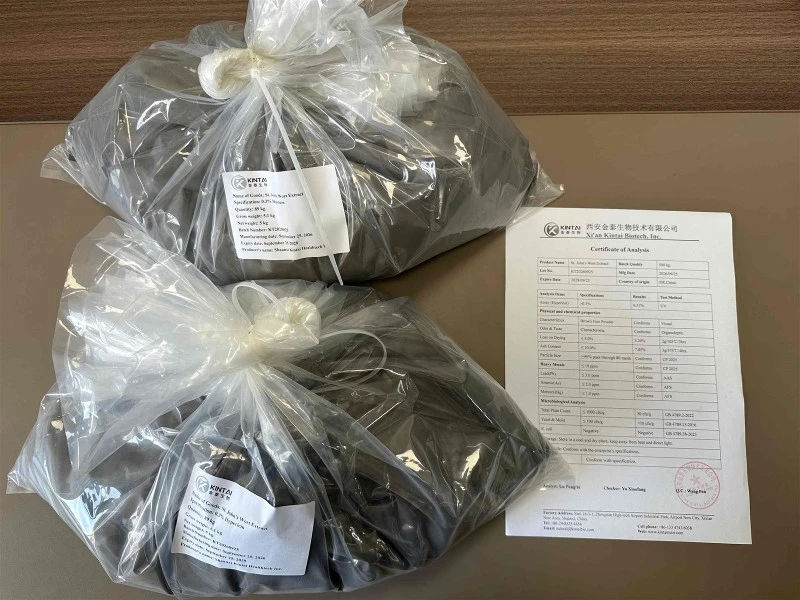
This article systematically compares the fundamental characteristics, research-backed mechanisms of action and applicable formulation scenarios of Hypericin and Hyperforin to help you efficiently select suitable St. John's Wort raw materials. Healthkintai® is a professional manufacturer of plant extracts. We supply standardized St. John's Wort extract 0.3% Hypericin. Manufactured in GMP workshops, every batch comes with a COA certificate of analysis, with full quality control covering pesticide residues, heavy metals and microbiological parameters. If you need bulk St John's wort extract powder, please contact us at health@kintaibio.com.

Hypericin Vs Hyperforin: What Are They?
What Is Hypericin?
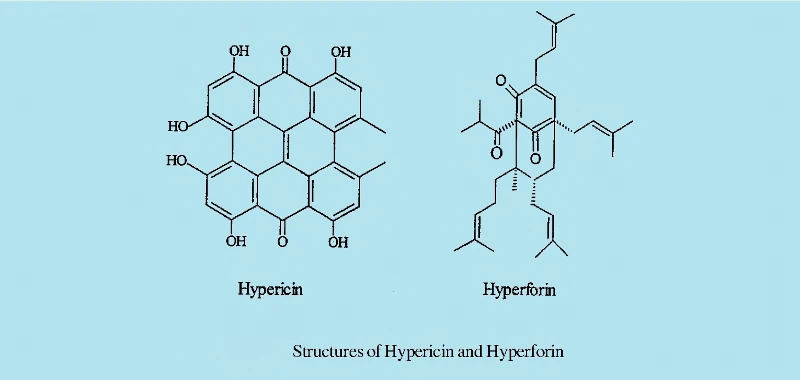
Hypericin (CAS: 548-04-9) is a natural naphthodianthrone compound isolated from Hypericum perforatum (St. John's Wort) of the Hypericaceae family, serving as a marker component of St. John's Wort extract. It appears as a reddish-brown to brown powder with low water solubility and solubility in organic solvents, featuring photochemical properties. Widely tested in botanical raw material research, numerous in vitro and preclinical studies have explored its antioxidant properties. Note that this ingredient carries phototoxic risks; excessive intake may trigger photosensitivity reactions. It is commonly applied in botanical extract R&D, laboratory research and product quality control.
What Is Hyperforin?
Hyperforin (CAS: 11079-53-1) is a unique polyisoprenylated phloroglucinol natural constituent found in Hypericum perforatum. It acts as a core quality control marker for St. John's Wort extract. This compound exhibits poor stability and is prone to oxidative degradation, alongside low water solubility. A large body of academic literature has investigated its effects on neurotransmitter transport, antibacterial and anti-inflammatory activities. This ingredient may modulate the human CYP450 enzyme system and has potential for interactions with other substances, making it a key active component in herbal formulation development and standardized raw material manufacturing.
Note: Hypericin is a stable, standardized mass production-suitable, and shelf-friendly quality control marker. Hypericin from the leaves has outstanding active potential, but it is extremely difficult to preserve and the formula cost is higher.
Hypericin Vs Hyperforin: Product Comparison Analysis
|
Comparison Dimension |
Hypericin |
Hyperforin |
|
Chemical Class |
Naphthodianthrone |
Phloroglucinol derivative |
|
Stability |
Relatively stable; only slowly degraded under prolonged strong light exposure, low loss under conventional storage |
Extremely unstable; rapidly oxidized and inactivated by light, heat and oxygen, degradation products are inactive |
|
Reported Mechanism of Action |
Photodynamic activity; in vitro studies demonstrate antioxidant effects and NF−κB inflammatory pathway modulation; traditionally used herbal soothing applications |
In vitro studies show modulation of reuptake of multiple neurotransmitters; abundant in vitro antibacterial research; activates PXR receptor with risks of ingredient-drug interactions |
|
Formulation Suitability |
Tablets, hard capsules, conventional solid dietary supplement dosage forms, suitable for long-shelf-life products |
Limited to custom formulations; strict requirements for packaging and storage conditions, not suitable for finished goods under long-term ambient circulation |
|
Mainstream Assay Method |
HPLC, mature industry application, pharmacopoeia-adopted, good test repeatability |
High difficulty for HPLC analysis; sample pretreatment must avoid light and oxygen, large fluctuation in test results |
|
Commercial Mainstream Specification |
0.3% Hypericin (general market standard) |
2%~5% high-content customized grade; regular commercial reference materials are generally not enriched intentionally |
|
Storage Challenges |
Cool, dry place with light-proof sealed packaging |
Full-process low temperature, light protection and nitrogen-flushed packaging; significantly higher warehousing and logistics cost |
|
Regulatory Considerations |
Compliant with US DSHEA and EU general botanical raw material notifications; well-established specifications and smooth review |
High-content products require additional labelling for storage risks and ingredient interaction warnings; more complicated registration |
Hypericin Vs Hyperforin: Benefits and Disadvantages
- Hypericin's most signature property is photodynamic activity, which enables it to generate reactive oxygen species upon light exposure. Multiple in vitro research papers verify that hypericin exhibits antioxidant potential and modulates the NF-κB signaling pathway, with related in vitro investigations focused on inflammatory regulation. Within traditional herbal applications, St. John's Wort extracts containing hypericin have long been incorporated into soothing herbal formulations.
A key advantage of this ingredient for formulation development lies in its excellent stability. The 0.3% hypericin grade serves as a global standardized specification that has been adopted for many years, compatible with most dietary supplement capsules and tablet formulations. Over a 24-month shelf life, finished products demonstrate controlled degradation of active constituents and consistent HPLC test results, helping customers' end products reliably pass third-party testing.
- Available in vitro research literature demonstrates that hyperforin broadly inhibits the reuptake of multiple neurotransmitters including serotonin, dopamine and norepinephrine in synaptosomes, while in vitro assays confirm its antibacterial activity. Nevertheless, this ingredient presents notable drawbacks for formulation use. Featuring a β-diketone structure, hyperforin is highly susceptible to oxidative degradation. Light exclusion is mandatory throughout production, and finished goods require nitrogen-flushed aluminum foil packaging. Should temperature control fail during storage, shipment and distribution, active content will decline rapidly.
Furthermore, published literature indicates hyperforin activates the PXR receptor, carrying potential risks of interactions with other pharmaceuticals or dietary ingredients. Extra compatibility assessments must be performed at the formulation development stage, which raises R&D costs and extends project timelines.
Where to Buy St. John's Wort Extract?
If you are searching for St. John's Wort raw material with consistent specifications, reliable test results and suitability for mass-production formulations of dietary supplements in Europe and North America, the standardized extract containing 0.3% hypericin stands as the preferred option for most projects.
Healthkintai® is a professional botanical extract manufacturer based in China. Our St. John's Wort Extract (0.3% Hypericin) delivers stable and continuous supply, supports sample evaluation, and provides a full set of technical documentation including COA, SDS, specification sheet, and TSE/BSE statement. Please feel free to contact us at health@kintaibio.com for detailed technical parameters, quotations, lead times, samples and complete documentation.