

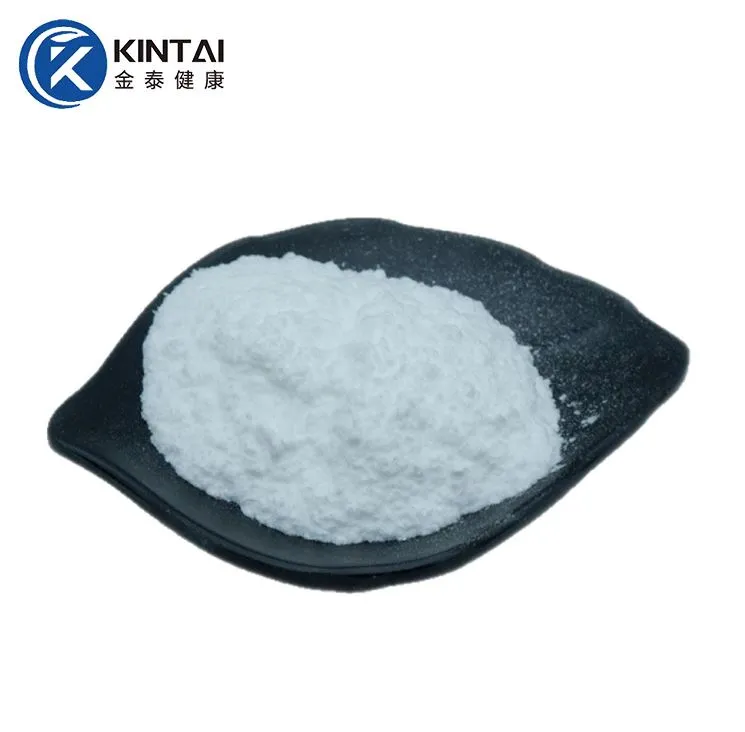


D-Biotin Vitamin B7 Powder Manufacturer/Factory/Supplier
D-Biotin, also known as Vitamin B7, Vitamin H or Coenzyme R, is a B-vitamin. Acting as a coenzyme for carboxylases, it participates in the metabolism of carbohydrates, lipids and amino acids. It nourishes hair and nails, repairs skin, and alleviates hair loss, dermatitis and brittle nails caused by biotin deficiency. Widely applied in health supplements, food fortification, cosmetic personal care, livestock and pet feed, it also serves as raw material for laboratory reagents and pharmaceutical preparations.
Healthkintai® specializes in R&D and production of dietary supplement raw materials. We supply D-Biotin Vitamin B7 Powder via chemical synthesis and bio-fermentation processes, with popular specifications of 1%, 98% and 99%. Warmly welcome your inquiries and orders. Please contact us at health@kintaibio.com.
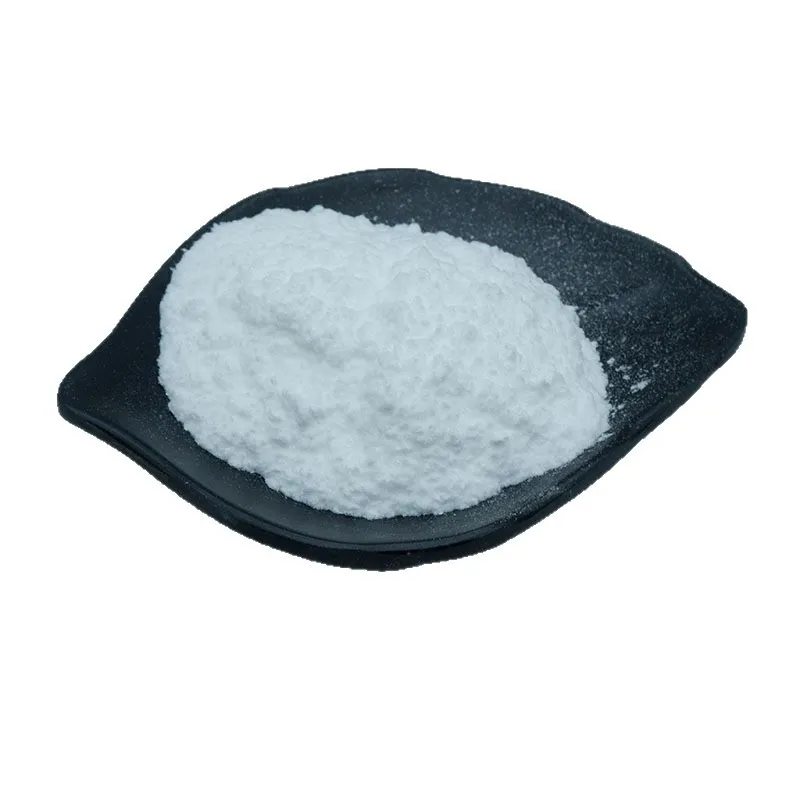
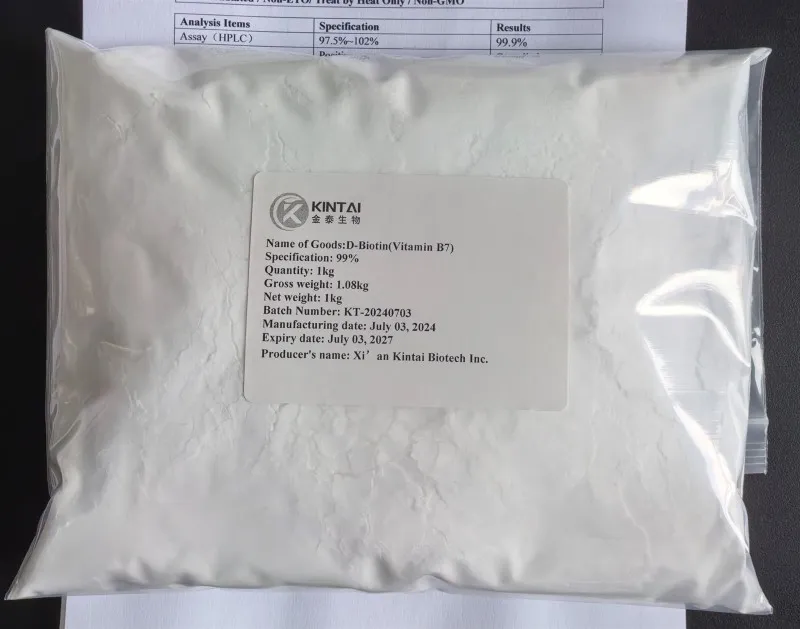
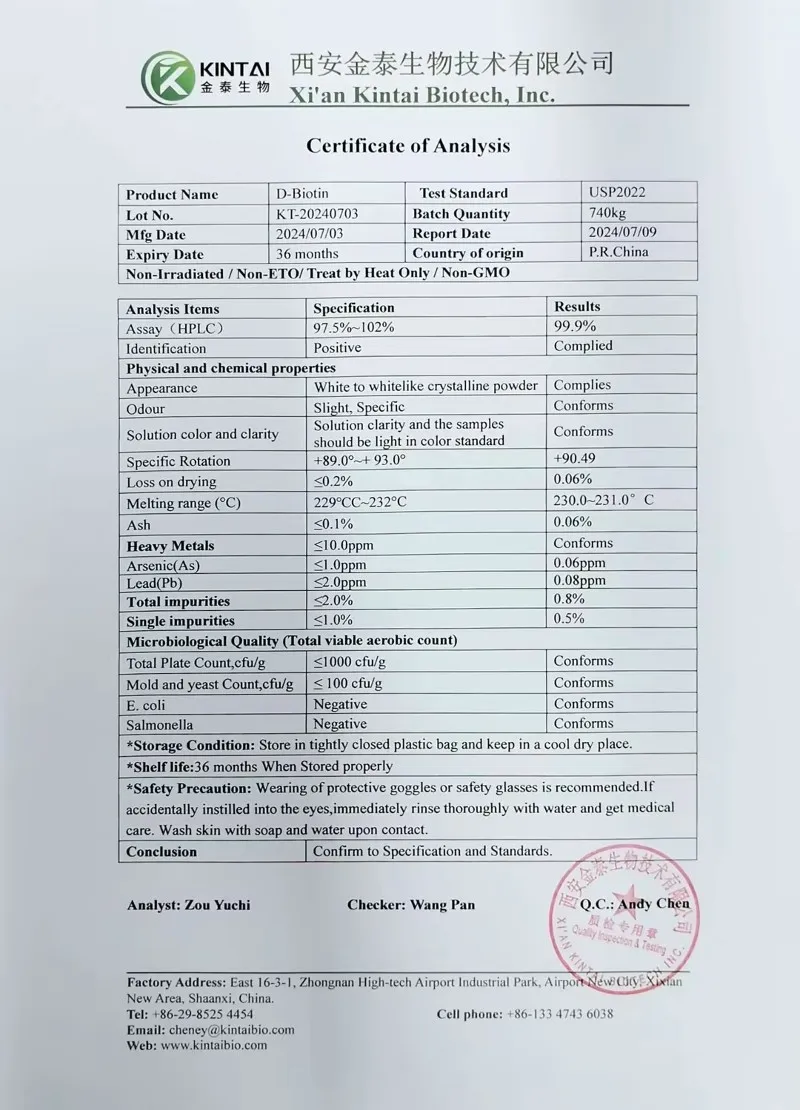
The COA of D-Biotin Vitamin B7 Powder
Is D-Biotin Vitamin B7 Water or Fat Soluble?
D-Biotin is a water-soluble B-group vitamin that cannot be stored long-term in the adipose tissue of humans and animals. Excess ingested biotin is scarcely retained in the body and mostly excreted via urine. Thanks to its water-soluble property, it dissolves readily in water when formulated into feeds, foods and pharmaceutical preparations, facilitating liquid batching, premix dilution as well as the production of oral liquids and injectable solutions.
Regulatory Status of D-Biotin Vitamin B7
JECFA and Codex Alimentarius Commission
Administered under WHO, JECFA has included D-Biotin in the General Standard for Food Additives with no specified acceptable daily intake limit following authoritative toxicological safety assessments. Endorsed by the CAC Codex, it is recognized as a universal vitamin fortificant serving as a regulatory benchmark for food legislation worldwide, permitted for nutritional fortification in conventional foods, infant formula and dietary supplements.
US FDA
D-Biotin is listed as GRAS by the US FDA and legally allowed for incorporation into common foods, infant formula and dietary supplements. Its pharmaceutical grade is specified in the USP monograph, and manufacturers may file Type II DMF for pharmaceutical registration applications. It is also approved as a legal nutritional feed additive without maximum residue limit requirements.
European Union (EFSA)
Following safety evaluation by EFSA, D-Biotin is authorized across the EU for food fortification, foods for special medical purposes and infant formula. Updated EU feed legislation harmonizes its approval for animal feed application throughout the bloc with no residual limits imposed, while its pharmaceutical grade is incorporated into the European Pharmacopoeia.
D-Biotin VS Biotin
Biotin is the general name for biotin, while D-Biotin refers to its biologically active dextrorotatory isomer. Among naturally occurring and commercially produced biotin, only the D-form possesses physiological activity, whereas inactive L-biotin exists merely as a by-product from synthesis. All biotin marked as Biotin in health supplements, food, feed and pharmaceutical raw materials actually consists of D-Biotin, meaning the two terms stand for the same Vitamin B7 in commercial applications. Their difference lies solely in naming standards: Biotin is the common abbreviated name, and D-Biotin is the precise official designation adopted in pharmacopoeias, COA test certificates and chemical documentation to exclude the inactive levorotatory isomer.
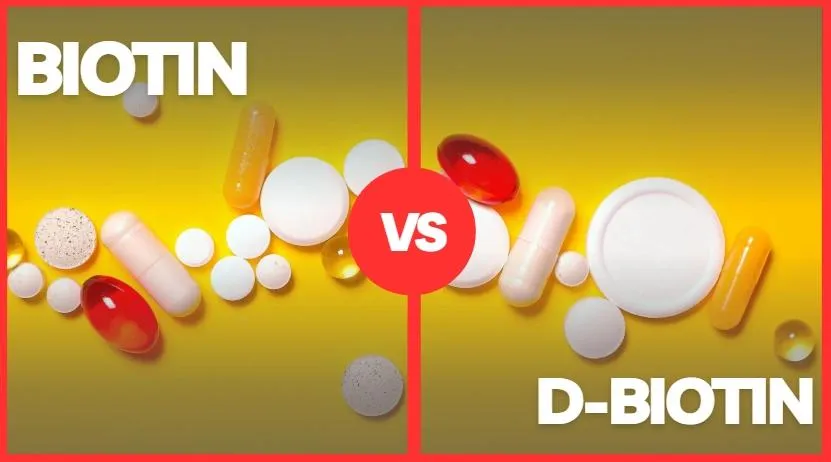
Difference between Biotin and D-biotin
|
Item |
Biotin (Common Name) |
D-Biotin (D-biotin, Active Isomer) |
L-Biotin (Levorotatory, Impurity) |
|
Stereoconfiguration |
General term encompassing both D and L chiral isomers |
Dextrorotatory chiral isomer, the naturally occurring configuration |
Levorotatory chiral isomer |
|
Physiological Activity |
Generic name, with activity dependent on the specific isomer |
100% biological activity, the only form utilizable by humans, animals and plants |
No vitamin activity, only a by-product of synthesis |
|
Product Labeling |
Abbreviated as Biotin on food and feed product labels |
Standardly labeled as D-Biotin on high-purity raw materials, pharmacopoeia standards, and COA (Certificate of Analysis) test reports |
Rarely used commercially, treated as an impurity control item |
|
Source |
General term for products from natural extraction or total chemical synthesis |
Mainstream commercial products produced via fermentation, whole-cell enzymatic method, or chemical synthesis |
Residual by-product from synthesis processes |
What Are the Benefits of D-Biotin Vitamin B7?
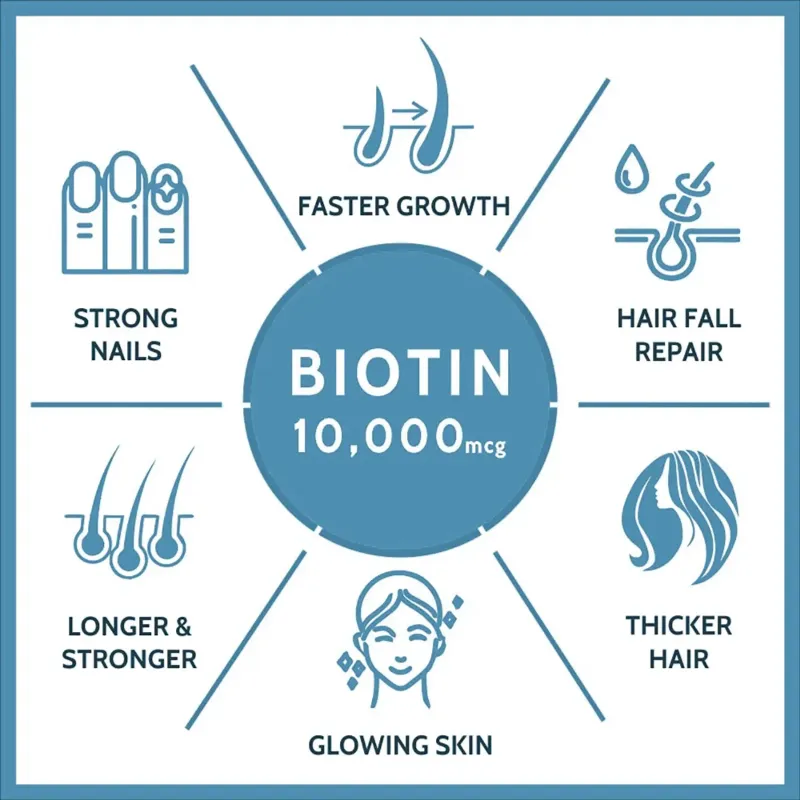
D-Biotin Vitamin B7 for Hair
As an essential coenzyme for carboxylase, D-biotin functions in two primary ways for hair health. On one hand, it catalyzes the carboxylation reactions required for keratin synthesis within follicular keratinocytes. As the core structural protein of hair shafts and hair follicle matrix, keratin production supported by sufficient biotin ensures normal proliferation and differentiation of hair germ cells, strengthening hair cuticles and hair root framework. On the other hand, it regulates lipid metabolism in scalp sebaceous glands to prevent excessive sebum secretion and subsequent follicular clogging. Meanwhile, it facilitates nutrient transportation via microcirculation of capillaries around hair follicles, delivering amino acids and energy substrates to dermal papilla cells. This alleviates follicular atrophy and telogen effluvium triggered by metabolic disorders, repairs damaged hair roots, relieves dryness, split ends and brittle fine hair, stabilizes the natural hair growth cycle at the follicular level and prevents abnormal hair loss.
D-Biotin Vitamin B7 for Nails
Nails are predominantly composed of hard keratin. By catalyzing carboxylation reactions during keratin synthesis in keratinocytes, biotin promotes the proliferation, differentiation of nail bed keratinocytes and the assembly of keratin, consolidating the fibrous structure of nail plates. Meanwhile, it improves microcirculation in the nail bed to continuously deliver metabolic nutrients to nail matrix cells, remedying thin, soft, layered, cracked and brittle nails resulting from inadequate keratin synthesis on nail surfaces. Additionally, it regulates lipid metabolism around nail folds to reduce hangnails and cuticle cracking, stabilizing nail growth starting from the nail matrix and boosting nail density and toughness.
D-Biotin Vitamin B7 for Skin
The epidermis is built up layer upon layer by keratin. Biotin catalyzes the carboxylation reactions required for the synthesis of epidermal keratinocytes, ensuring their orderly proliferation and differentiation and preserving the integrity and compactness of the stratum corneum as the skin barrier. Meanwhile, it regulates lipid synthesis and metabolism in sebaceous glands to curb abnormal excessive sebum secretion, alleviating greasy skin and clogged pores. In addition, it boosts dermal microcirculation, delivers nutrients to fibroblasts, facilitates collagen synthesis, and repairs damaged skin with dry flaking and rough scaling.
D-Biotin Vitamin B7 Uses
D-Biotin Vitamin B7 Food and Dietary Supplements
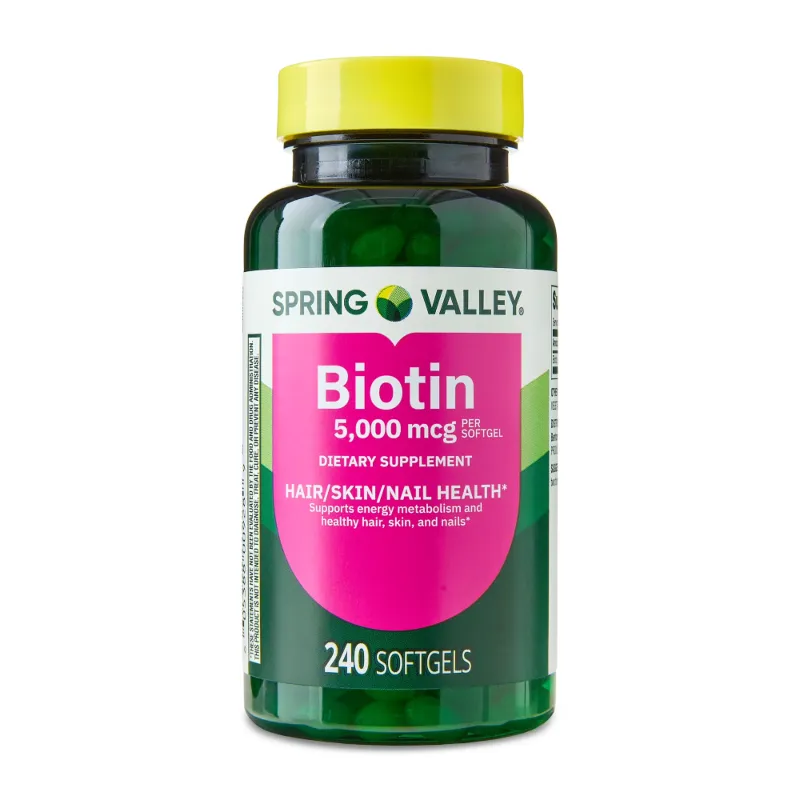
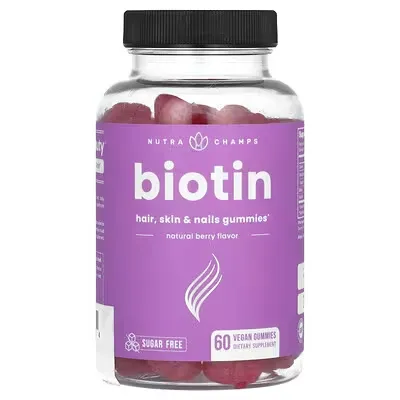
As a food-grade 99% D-Biotin nutritional fortificant, it is legally incorporated into conventional food products including infant formula milk powder, modified milk, solid beverages, grain meal replacements, energy bars and baked goods. For functional dietary supplements, D-Biotin is widely formulated into oral gummies, tablets, effervescent tablets and powders for hair and nail health benefits, with a typical single-serving dosage ranging from 2500 μg to 5000 μg. It is frequently compounded with zinc, silicon and MSM sulfur to develop proprietary hair & nail support blends. In addition, D-Biotin is a standard ingredient in prenatal multivitamins and senior B-complex vitamin formulations.
D-Biotin Vitamin B7 For Pharmaceutical Use
Pharmaceutical-grade D-Biotin is an essential clinical pharmaceutical raw material, primarily indicated for hereditary biotinidase deficiency and carboxylase metabolic disorders. In addition, as an active ingredient for compound B-complex vitamin preparations, it aids in the adjuvant treatment of complications induced by biotin deficiency, including seborrheic dermatitis, unexplained alopecia, peripheral nerve damage and chronic dermatitis. It is also added in trace amounts to injection solutions and parenteral nutrition infusions to supply nutritional support for postoperative and critically ill patients.
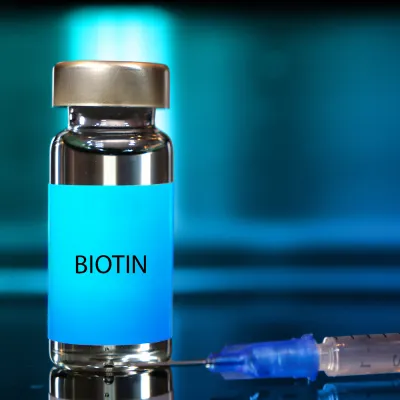
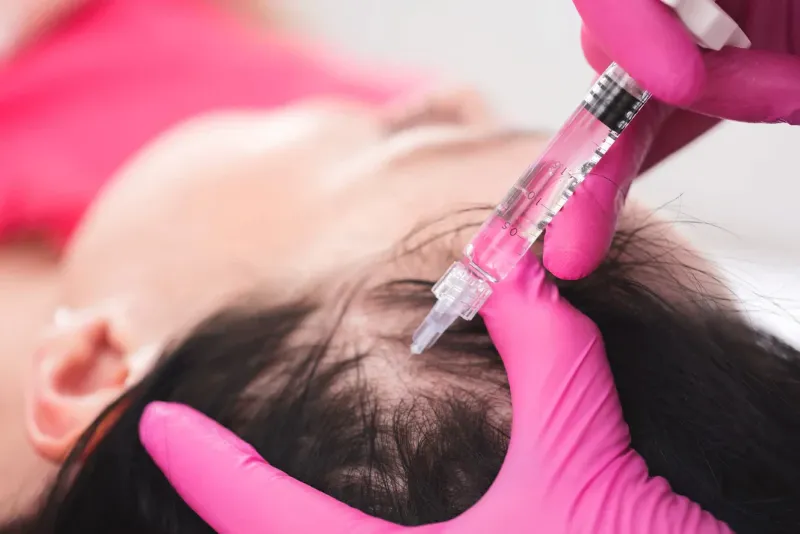
D-Biotin Vitamin B7 in Personal Care Products
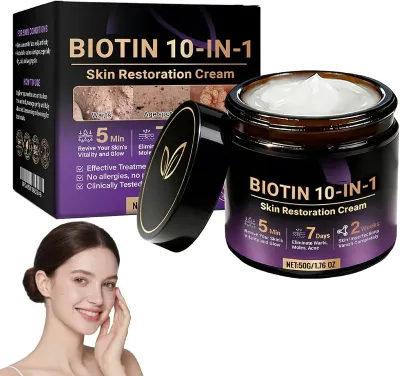
Cosmetic-grade D-Biotin is widely applied in three major categories: hair care, nail care and skincare. Its dominant applications lie in shampoos, conditioners, hair masks and scalp serums, where it is combined with niacinamide, caffeine and panthenol in formulations. Such products claim to repair scalp barrier, strengthen hair roots and alleviate fine hair and excessive hair loss. Within nail care lines, it is incorporated into nail repair serums and nail strengtheners to thicken nail bed keratin and improve thin, layered and brittle nails. For skincare, it is dosed sparingly in repairing creams and essences to help regulate cutaneous keratin metabolism and relieve excessive sebum secretion as well as redness of seborrheic skin.


D-Biotin Vitamin B7 in the Feeds
D-Biotin is extensively supplemented in complete feeds and compound premixes for swine, poultry, ruminant dairy cattle, aquatic species and equine animals. Proper dietary supplementation effectively prevents swine hoof cracking, dermatitis and alopecia as well as reproductive disorders in breeding pigs; it alleviates pododermatitis, rough plumage and low hatchability of hatching eggs in poultry, and improves hoof health and milk fat synthesis efficiency in dairy cows. When incorporated into aquafeed, D-Biotin reduces skin ulceration of fish and shrimp while enhancing their anti-stress capacity and feed conversion ratio (FCR).
How Much D-Biotin Vitamin B7 Should I Take per Day?
For ordinary healthy adults, a daily supplemental dose of 30-100 μg meets basic physiological requirements for daily health maintenance. When supplemented for improving hair quality and brittle nails, the commonly adopted dosage for dietary supplements ranges from 2500 μg to 5000 μg per day. As biotin is water-soluble, surplus intake is eliminated through urine, granting it a favorable safety profile. Pregnant and lactating women are advised to follow recommended dietary intake under medical guidance and avoid long-term excessive supplementation without authorization.
Where to Buy D-Biotin Vitamin B7 Powder?
Healthkintai® has over ten years of expertise in the R&D and production of nutritional and cosmetic raw materials, specializing in powdered D-Biotin available across purity grades from 1% to 99%. Products are manufactured via either fermentation synthesis or chemical synthesis routes, resulting in differentiated pricing accordingly. All production is performed in strict compliance with GMP quality management standards. The company holds a full set of export qualification and compliance certificates and can assist overseas clients with customs clearance procedures for import and export shipments.
For wholesale D-Biotin Vitamin B7 Powder, contact us at health@kintaibio.com.
FAQ
Q: Is biotin and d-biotin the same?
A: Commonly referred to as biotin in commercial trade essentially means D-Biotin. Biotin has two chiral isomers: D-form and L-form. Only D-Biotin is biologically active, whereas L-Biotin can barely be absorbed and utilized by humans and animals. All biotin labeled on feed, food, pharmaceutical and cosmetic raw materials available on the market is D-Biotin, and the abbreviated trade name "biotin" uniformly stands for D-Biotin, so the two terms refer to the same active raw material in commercial applications.
Q: Is biotin good for fertility?
A: Proper supplementation of biotin benefits fertility preparation, pregnancy and breeding of livestock and poultry. For human health, adequate D-Biotin participates in the metabolism of protein, fat and carbohydrates, optimizes endocrine metabolism, relieves dermatitis, hair loss and metabolic disorders caused by biotin deficiency, and creates a stable internal environment for the development of ova and sperms. Sufficient intake during pregnancy also lowers the risk of fetal developmental abnormalities resulting from maternal biotin shortage. In livestock farming, feed-grade biotin effectively reduces reproductive disorders in breeding swine and poultry, improves conception rates and egg hatchability, and decreases abortion and weak offspring. Nevertheless, dosage should follow regulatory standards to avoid excessive blind supplementation.
Hot Tags: d-biotin vitamin b7 powder, China d-biotin vitamin b7 powder manufacturers, suppliers, factory


