


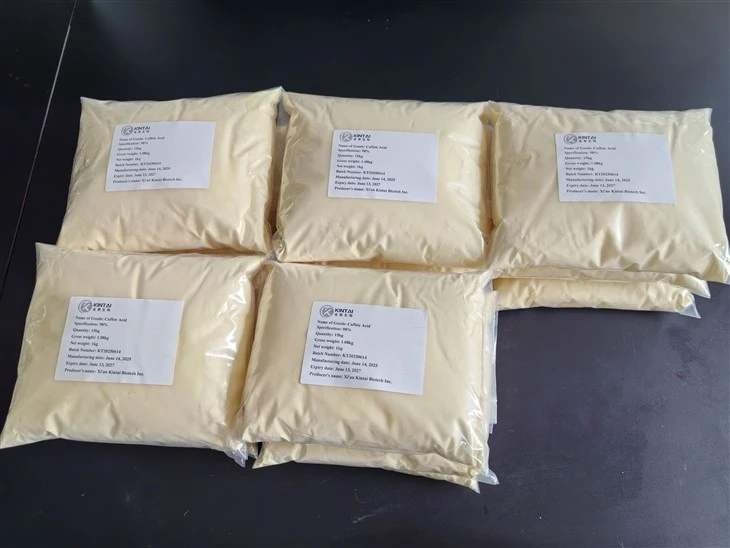


Caffeic Acid Powder Supplier/Manufacturer/ Factory
Caffeic acid (3,4-dihydroxycinnamic acid) is a natural phenolic compound of the hydroxycinnamic acid class. It appears as a pale yellow crystalline powder, with its main caffeic acid food sources including coffee, tea, various fruits, vegetables, and propolis. Possessing multiple biological activities such as antioxidant, anti-inflammatory, and antibacterial properties, it is a high-value natural active ingredient widely used in pharmaceuticals, cosmetics, food, and health care products.
Healthkintai® is a leading food additive supplier in China. Our caffeic acid powder features high purity (98% and 99%), no additives, and no harmful solvent residues. You can cooperate with us with full confidence and contact us at health@kintaibio.com.


The COA of Healthkintai's Caffeic Acid Powder

The Physical and Chemical Properties of Caffeic Acid
|
Item |
Specification |
|
Caffeic Acid Melting Point |
Approx. 211–213 ℃ |
|
Caffeic Acid Solubility |
Slightly soluble in cold water, sparingly soluble in hot water, freely soluble in ethanol, methanol, ethyl acetate and other organic solvents |
|
Caffeic Acid Chemical Activity |
Strong reducibility and antioxidant activity |
|
Caffeic Acid Stability |
Easily oxidized and discolored under light, high temperature and alkaline conditions |
|
Caffeic Acid Molecular Formula |
C₉H₈O₄ |
|
Caffeic Acid Molecular Weight |
180.16 |

Chemical structure of caffeic acid
Caffeic Acid and Caffeine
Caffeic acid and caffeine are two completely different chemical compounds with no direct connection in structure, properties, or functions. They only coexist in coffee beans, which is why their names are similar.
Caffeic acid is a phenolic acid compound that mainly exerts antioxidant and anti-inflammatory effects. In contrast, caffeine is an alkaloid and a central nervous system stimulant with refreshing and wakefulness-promoting effects. The two differ significantly in application fields and physiological activities.

Contact us for free samples now. >>>
What Are the Benefits/Uses of Caffeic Acid?

Caffeic Acid Antioxidant effect
The molecular structure of caffeic acid contains two phenolic hydroxyl groups. These two active groups can actively scavenge excess reactive oxygen species in the body and convert free radicals into stable inert molecules through redox reactions, thereby terminating the chain oxidation reactions triggered by free radicals. At the same time, caffeic acid can activate the activity of the body's antioxidant enzyme system, enhance the body's own antioxidant capacity, and slow down the process of cell senescence. It also inhibits oxidation-induced deterioration and discoloration in food, cosmetics and other products, making it a natural and highly effective antioxidant.
Caffeic Acid Anti-inflammatory effect
Caffeic acid is a natural anti-inflammatory active substance that exerts its anti-inflammatory effects mainly by regulating inflammatory signaling pathways and inhibiting the release of inflammatory factors. It can reduce inflammatory responses such as redness, swelling, exudation and pain in local tissues by suppressing the release of inflammatory factors. In addition, caffeic acid can inhibit the synthesis of inflammatory mediators and has a significant alleviating effect on acute and chronic inflammation, including skin inflammation, mucosal inflammation and joint inflammation. It has no obvious side effects and is suitable for long-term use in
anti-inflammatory related products.


Caffeic Acid for Skin
The core role of caffeic acid in skin care lies in the synergistic effects of antioxidation, anti-inflammation and skin repair.
- Caffeic acid scavenges free radicals on the skin surface, inhibits UV (UVA/UVB)-induced oxidative stress, promotes the synthesis and maintenance of collagen, and delays skin sagging, fine lines and dry lines. It also inhibits tyrosinase activity in melanocytes, reduces melanin production and deposition, improves dull skin and dark spots, thus achieving whitening and anti-aging effects.
- The anti-inflammatory effect of caffeic acid relieves skin inflammatory responses and improves redness, dryness, stinging and other issues in sensitive and damaged skin.
Does Caffeic Acid Have Side Effects?
At normal dosages, caffeic acid, as a natural plant extract, is generally safe with no obvious serious side effects. A small number of people may experience mild gastrointestinal discomfort such as bloating, diarrhea, or nausea, which can be relieved after discontinuation. Long-term excessive use at high concentrations may increase the body's metabolic burden. Topical application may occasionally cause temporary redness or irritation in sensitive skin, so a skin test is recommended before use.
Caffeic acid is classified as Group 2B carcinogen by IARC, which is mainly based on high-dose animal studies. There is currently no clear evidence that normal and compliant use is carcinogenic to humans. It is relatively safe for use in food, cosmetics, and health products under relevant regulations.

Where to Buy Caffeic Acid Powder?
Caffeic acid is a high-quality natural plant extract. Healthkintai® has been deeply engaged in the field of plant extracts for more than ten years, with mature production technology and extensive industry experience. Our company offers products with stable purity, complete specifications, and full qualifications and has established long-term and stable cooperative relationships with many customers worldwide. We provide caffeic acid powder with purity up to 99% and support personalized customization according to your requirements. Welcome to discuss wholesale cooperation at health@kintaibio.com, and we look forward to working with you.

FAQ
Q: What is another name for caffeic acid?
A: Caffeic acid is also known as 3,4-dihydroxycinnamic acid, which is its systematic chemical name based on its molecular structure. This is the most widely recognized alternative name used in chemistry, pharmaceuticals, cosmetics, and plant extract-related fields.
Q: Which foods are high in tryptophan?
A: Foods high in tryptophan (an essential amino acid for serotonin/melatonin) are generally protein-rich, including poultry (turkey, chicken), fish (salmon, tuna), dairy (milk, cheese, eggs), soy products (tofu, edamame), nuts and seeds (pumpkin, sesame, sunflower, cashews), and grains (oats, quinoa), with some fruits like bananas also containing it. Turkey and chicken are often cited, but seeds, fish, and tofu offer concentrated amounts.
Reference:
https://en.wikipedia.org/wiki/Caffeic_acid
https://www.sciencedirect.com/science/article/pii/S1756464623002372
https://pubmed.ncbi.nlm.nih.gov/28463788/
Hot Tags: caffeic acid powder, China caffeic acid powder manufacturers, suppliers, factory, Caffeic Acid Powder, edible bamboo charcoal powder, Stevia Leaf Extract Powder, food additives, Ginger Extract Powder, L rhamnose Monohydrate Powder


