

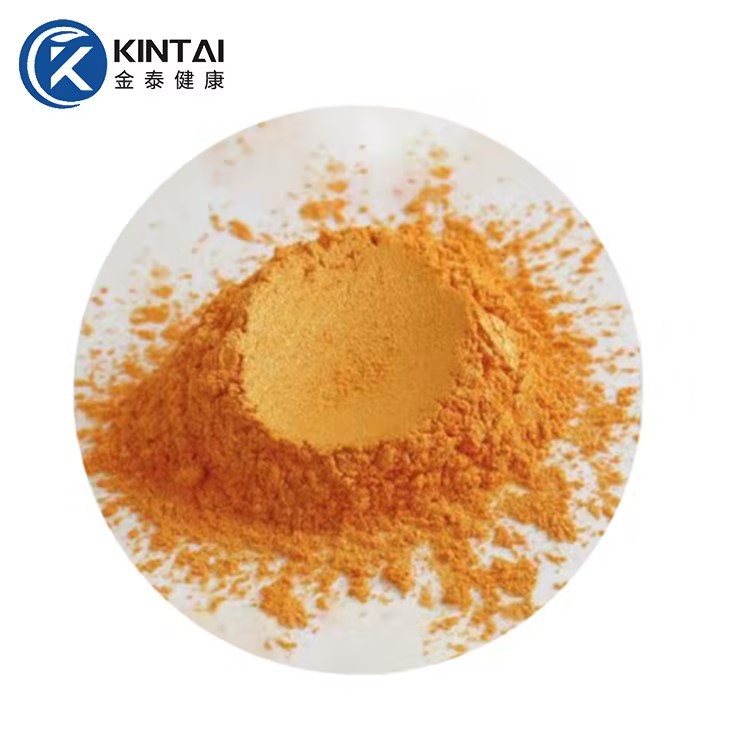

Fucoxanthin Powder Factory/Manufacturer/Supplier
The vast ocean nurtures abundant brown seaweed resources, whose extracts contain a rare active ingredient known as "algae gold"- fucoxanthin (fucoxanthine). As a unique carotenoid found in brown seaweed, fucoxanthin is not only the key pigment responsible for the distinctive color of brown seaweed but also exhibits powerful physiological activities, including antioxidation, anti-inflammation, lipid metabolism regulation, mitochondrial activation, and cell protection due to its special molecular structure, making it a hotspot in the research and development of marine natural products.
Fucoxanthin powder from Healthkintai® is widely used in weight management dietary supplements, high-end anti-aging skincare products, functional foods, pharmaceutical intermediates, and other fields. We support OEM/ODM customized services. Please feel free to contact us at health@kintaibio.com if you have any inquiries.
|
Item |
CAS NO. |
Specification |
Test Method |
|
Fucoxanthin |
3351-86-8 |
10%, 20%, 50% |
UV |
|
≥1% |
HPLC |
||
|
≥5% (oil) |
HPLC |
||
|
9072-19-9 |
95%, 98% |
HPLC |
|
|
≥40%, ≥70% |
UV |


The TDS of Fucoxanthin Powder
|
Item |
Specification |
Testing method |
|
Assay |
Fucoxanthin ≥50% |
HPLC |
|
Appearance(Color) |
Light yellow to brown powder |
Organoleptic |
|
Particle Size |
95% Through 80 mesh |
USP<786> |
|
Loss on drying |
≤5.0% |
GB 5009.3 |
|
E.Coli |
Negative |
GB 4789.3 |
|
Salmonella |
Negative |
GB 4789.4 |
|
Heavy Metals (Total) |
≤10.0ppm |
/ |
|
Arsenic(As) |
≤ 1.0ppm |
ICP-MS |
|
Lead(Pb) |
≤ 3.0ppm |
ICP-MS |
|
Mercury(Hg) |
≤ 0.1ppm |
ICP-MS |
|
Cadmium(Cd) |
≤ 1.0ppm |
ICP-MS |
Is Fucoxanthin Safe?
Fucoxanthin has high overall safety and is generally safe for oral and topical use at recommended dosages. It is widely recognized as a mild, natural active ingredient in the fields of weight management, antioxidation, and functional foods.
Fucoxanthin regulations and management: as a natural carotenoid derived from brown algae, fucoxanthin has passed numerous toxicological and safety evaluations. It is approved for use as a raw material for dietary supplements, food additive, or novel food ingredient in the United States, Japan, the European Union, and many other regions.
Fucoxanthin side effects: existing research and practical applications show that there are almost no obvious adverse effects at recommended dosages. Only a very small number of individuals may experience mild gastrointestinal discomfort with long-term high-dose intake. Topical use in skincare products also rarely causes irritation or allergic reactions, demonstrating good overall tolerability.
Difference between Fucoidan and Fucoxanthin
Fucoidan and fucoxanthin are two distinct active substances derived from brown algae. Fucoidan is a water-soluble sulfated polysaccharide mainly found in the intercellular matrix of brown algae, with core functions including protecting the gastric mucosa, regulating intestinal flora, enhancing immunity, anti-Helicobacter pylori activity, anticoagulation and antioxidant activity.
In contrast, fucoxanthin is a fat-soluble carotenoid and the pigment component of brown algae, whose key effects focus on potent antioxidant, anti-inflammatory, fat-burning, metabolic regulation and anti-tumor activities. The two differ significantly in chemical structure, solubility, action targets and physiological functions and should not be confused.

What Is Fucoxanthin Used for?

Fucoxanthin for Weight Loss
Fucoxanthin achieves thermogenesis and energy consumption by activating UCP1 protein to promote the browning of white fat. Meanwhile, it activates the AMPK pathway, inhibits PPARγ and key enzymes involved in fat synthesis, reduces fat production, and accelerates fatty acid oxidation.
It also improves insulin sensitivity, reduces insulin-mediated fat accumulation, regulates intestinal flora, repairs the intestinal barrier, and alleviates chronic inflammation associated with obesity. Through multi-target synergistic effects on fat burning, fat control, glucose stabilization, anti-inflammation, and appetite regulation, fucoxanthin enables safe and long-term weight management and visceral fat control.
Fucoxanthin for Antioxidation
As a type of carotenoid and a potent natural antioxidant, fucoxanthin contains conjugated double bonds and an epoxyketone structure in its molecule, enabling it to directly scavenge various reactive oxygen species and free radicals in the body.
It also upregulates endogenous antioxidant enzymes such as SOD, CAT, GSH-Px, and HO-1 by activating the Nrf2 signaling pathway, inhibits the NF-κB inflammatory pathway to alleviate chronic inflammation caused by oxidative stress, and protects mitochondrial structure and function while reducing lipid peroxidation, thereby exerting strong and stable antioxidant effects through multiple mechanisms.

Fucoxanthin Uses
For Nutritional Supplements and Functional Foods
As a key ingredient for weight management, fucoxanthin is a popular choice for fat-loss soft capsules, tablets, and powders. Meanwhile, its strong antioxidant and anti-inflammatory properties support supplements for antioxidation, liver protection, and metabolic regulation, suitable for healthy individuals and those with slow metabolism. In functional foods, it can also be added as a natural yellow pigment to baked goods, dairy products, and healthy snacks, providing both coloration and antioxidant effects to meet clean-label requirements.


For Skin Care and Cosmetics
In topical skin care, fucoxanthin protects skin cells by scavenging free radicals and inhibiting UV-B-induced oxidative stress. It also inhibits MMPs and promotes collagen synthesis, making it widely used in anti-wrinkle creams, sunscreens, serums, and repair masks, earning a reputation as a "natural alternative to retinol".


How Much Fucoxanthin Should I Take?
There is currently no unified official dosage for fucoxanthin in human applications. Mainstream research and commercial products mostly adopt a daily dosage range of 1–24 mg, among which a daily dosage of 2–10 mg is commonly used in products for weight management and metabolic regulation, while 1–5 mg per day is typical for health care purposes such as antioxidation and liver protection. High-dose studies generally do not exceed 24 mg per day, and administration is usually conducted in cycles of 8–12 consecutive weeks. Absorption can be improved with fat-soluble carriers or meals containing fat.
Where Can I Buy Fucoxanthin?
Fucoxanthin is derived from high-quality brown seaweed. As a leading manufacturer and supplier of plant extracts in China, Healthkintai® carefully selects premium brown seaweed raw materials and relies on mature and stable extraction processes to supply high-purity, cost-effective fucoxanthin powder in bulk. Please feel free to contact us at health@kintaibio.com.
- Our company offers a complete range of fucoxanthin specifications that can precisely meet different formulation development needs for health supplements, functional foods, beauty, and skincare products.
- We support ODM & OEM customization and welcome your inquiries.
- We maintain a complete set of qualifications, including HACCP and Halal certification, with strict quality control systems implemented throughout the entire production process from raw material sourcing to manufacturing and finished product inspection.

FAQ
Q: Can fucoxanthin improve brain function?
A: Yes, it can. Fucoxanthin has the potential to improve brain function. Studies have shown that it exerts effects through antioxidant, anti-inflammatory, and neuroprotective mechanisms, reducing oxidative stress and chronic inflammatory damage in the brain, inhibiting neuronal apoptosis, and helping to improve cerebral metabolism and microcirculation, thus playing a positive role in maintaining cognitive function and alleviating memory decline.
Q: Is fucoxanthin good for your skin?
A: Fucoxanthin provides significant benefits to the skin. With strong antioxidant properties, it scavenges free radicals, reduces photoaging damage caused by ultraviolet rays, and inhibits inflammatory responses. It also reduces the degradation of collagen and elastic fibers, helping to improve skin dryness, dullness, and fine lines. In addition, it repairs the skin barrier and soothes sensitive redness, showing excellent application value in brightening skin tone and anti-wrinkle and firming, as well as sun protection and repair, making it a highly desirable active ingredient for skincare.
Hot Tags: fucoxanthin powder, China fucoxanthin powder manufacturers, suppliers, factory, Lemon Extract Powder, cuspidatum root, Rosemary Extract Powder, Tannic Acid Powder, Sclareol Powder, polygonum cuspidatum root extract resveratrol


