


Mulberry Leaf Extract Powder Supplier/Factory/Manufacturer
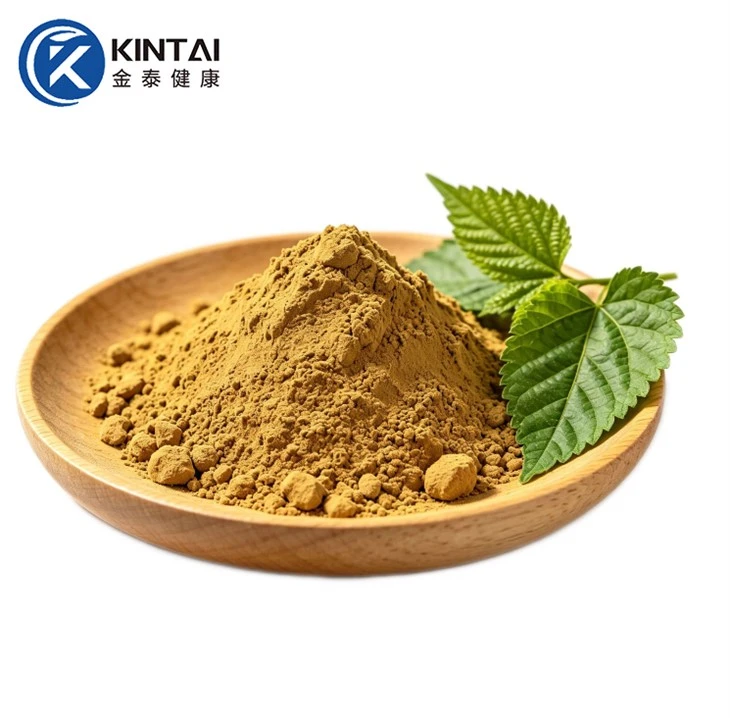
Mulberry leaf extract (also know as folium mori extract) is primarily derived from the dried leaves of the white mulberry plant (Morus alba L.). So it is also called white mulberry leaf extract. Its health benefits are largely attributed to a variety of active components, including alkaloids (especially 1-deoxynojirimycin, or DNJ), flavonoids, polysaccharides, and polyphenols. Modern research has confirmed that these natural substances work synergistically to exert multiple physiological effects, such as helping to regulate blood sugar, support weight control, provide antioxidant protection, and reduce inflammation. These properties have made mulberry leaf extract highly sought after across various industries. Today, it is widely used in health foods, functional foods, pharmaceuticals, cosmetics, and personal care products.
Healthkintai® can be your best professional partner in the field of plant extract, because we have been focused on it for over one decade. Our top-selling specification of Mulberry leaf extract powder is 1% and 5% DNJ, but other specifications are also available. If you require natural mulberry leaf extract powder produced via water extraction without harmful solvent residues, please feel free to contact us at health@kintaibio.com.
|
Item |
Specification |
Extraction Technology |
Test Method |
|
Mulberry leaf extract DNJ powder |
1% DNJ |
Water extraction |
HPLC |
|
5% DNJ |
HPLC |
||
|
Mulberry leaf extract |
10:1 (water-soluble) |
TLC |
|
|
30:1 (water-soluble) |


The COA of Mulberry Leaf Extract DNJ Powder

Regulatory Status of Mulberry Leaf Extract DNJ
In the United States
In the United States, mulberry leaf is classified as a dietary supplement ingredient with a long history of consumption, which does not require an NDI (New Dietary Ingredient) filing. Only mild functional claims such as supporting healthy glucose metabolism and antioxidant activity are permitted. High-purity mulberry leaf extracts intended for food applications must complete a GRAS Notice submission; there is currently no general GRAS qualification for mulberry leaf extracts with a no-objection letter issued by the FDA. The industry generally self-regulates the daily intake of DNJ to a maximum of 50 mg.
EU
Conventional low-concentration aqueous mulberry leaf extracts can be circulated directly as food supplement raw materials in the EU, while high-purity DNJ concentrated extracts are classified as Novel Foods and must pass the centralized EU Novel Food approval before being placed on the market. The EFSA has issued a safety opinion setting a maximum safe daily intake limit of 50 mg for DNJ. Regulations only permit claims related to supporting normal carbohydrate metabolism, and stringent import testing standards are enforced for pesticide residues and organic solvent residues in raw materials.
Japan
Mulberry leaf is categorized as a general food raw material in Japan, with low market access barriers for mulberry leaf tea and mulberry leaf powder. Functionally Labeled Foods represent the mainstream compliant products; enterprises may legally claim benefits such as suppressing postprandial blood glucose elevation and regulating neutral fat after completing document filing prior to launch. Regulators impose a strict daily DNJ intake cap of 10 mg per single product. Imported raw materials must comply with unified limit standards covering hundreds of pesticide residues. Additionally, mulberry leaf is included in the Japanese Kampo pharmacopoeia and can be utilized as a pharmaceutical raw material.
South Korea
South Korea's MFDS has included mulberry leaf extracts in the standard ingredient list for health functional foods, which can be directly applied to the production of functional foods. Highly concentrated DNJ products may also apply separately for functional ingredient qualification. Products are allowed to carry statements related to supporting healthy blood glucose levels and antioxidant effects, with the daily maximum DNJ intake capped at 50 mg in line with international common standards. Complete quality test reports are required for both ordinary mulberry leaf foods and finished functional products, with strict controls over heavy metal and pesticide residue levels.
Mulberry Leaf Extract Powder Botanical Source
Our mulberry leaf extract powder is derived from the authentic raw material recorded in the Pharmacopoeia of the People's Republic of China -the dried white mulberry (Morus alba L.) leaves.
We select high-quality raw materials from core advantageous producing areas such as Tongxiang in Zhejiang, Hanzhong in Shaanxi, and Nanchong in Sichuan. The mulberry leaves grown in these regions are not only naturally rich in active ingredients like DNJ and flavonoids but also harvested after the first frost, boasting far superior medicinal efficacy and nutritional value compared to ordinary mulberry leaves.
Adopting the low-temperature cold extraction and purification process, combined with spray drying technology, our product not only retains over 95% of the active ingredients in their entirety but also features uniform particle size and excellent instant solubility.

How to Make Mulberry Leaf Extract?
DNJ is an aminocyclitol with extremely high polarity and high water solubility. Purified water extraction leaves no organic solvent residues, making it suitable for dietary supplements and food raw materials.

Key Control Points for Each Process Section
- Extraction: Maintain temperature at 70°C; temperature exceeding 80°C is prohibited, as DNJ is prone to degradation.
- Impurity Removal: Operate at pH 4.0–4.5 (protein isoelectric point); adopt dual-stage membranes of 5000 Da and 1000 Da.
- Resin Treatment: DNJ cannot be adsorbed by macroporous resins; only cation exchange resins capture its amino structure.
- Concentration & Drying: The whole process shall be kept at a low temperature of ≤60°C to preserve DNJ activity.
Sample available! Contact us to get more details. >>>
What Are the Benefits of Mulberry Leaf Extract DNJ?
Mulberry leaf extract for blood sugar
Mulberry leaf extract is a premium natural raw material for auxiliary blood sugar regulation. Its core hypoglycemic active ingredients include 1-deoxynojirimycin (DNJ), mulberry leaf polysaccharides and mulberry leaf flavonoids, which work synergistically to support balanced blood sugar management. 1 deoxynojirimycin (dnj) competitively inhibits the activity of intestinal α-glucosidase, slowing down the breakdown of carbohydrates from staple foods such as rice and noodles into glucose and delaying sugar absorption. It effectively lowers postprandial blood sugar peaks and prevents drastic blood sugar fluctuations after meals.
Mulberry leaf polysaccharides repair damaged pancreatic β-cells, boost normal insulin secretion, improve insulin sensitivity in peripheral tissues including muscles and the liver, alleviate insulin resistance, and accelerate the uptake and metabolism of glucose in the bloodstream. Mulberry leaf flavonoids suppress hepatic gluconeogenesis to reduce glucose release from the liver during fasting, stabilizing fasting blood glucose levels. They also relieve oxidative stress and chronic inflammation induced by high blood sugar, mitigating vascular damage caused by hyperglycemia.

Reference: https://www.sciencedirect.com/science/article/pii/S075333221838658X
Mulberry leaf extract for weight loss
Mulberry leaf extract offers multiple supportive benefits for weight management. It can reduce the absorption of dietary carbohydrates and fats by inhibiting the activities of intestinal α-glucosidase and lipase, thereby lowering caloric intake at the source. At the same time, its active components regulate enzymes and signaling pathways involved in lipid metabolism, suppressing the formation of new fat cells while promoting the breakdown and oxidation of existing fat, thus reducing body fat accumulation.
Furthermore, mulberry leaf extract can modulate the structure of gut microbiota, correcting dysbiosis induced by a high‑fat diet, and reduce chronic inflammation levels, which in turn improves insulin sensitivity and helps control body weight and decrease visceral fat.

Reference: https://www.sciencedirect.com/science/article/abs/pii/S0944711324001934
Mulberry leaf extract for skin
DNJ, mulberry leaf flavonoids and polysaccharides can repair and improve skin conditions through multiple pathways.
Flavonoids deliver powerful antioxidant effects to eliminate free radicals in the skin, inhibit tyrosinase activity to block melanin formation and fade dullness and pigment spots, alleviate oxidative photoaging damage, and suppress the release of pro-inflammatory factors to relieve redness and swelling caused by acne. DNJ regulates skin glycation reactions and modulates cutaneous glucose metabolism to reduce triggers of acne at the source. Mulberry leaf polysaccharides repair damaged skin barriers, boost the water-locking capacity of the stratum corneum, soothe redness and sensitive skin, balance sebum secretion by regulating skin lipid metabolism, clear accumulated oils in pores, and improve closed comedones, open comedones and recurring breakouts.
Mulberry Leaf Extract vs. Berberine
Mulberry leaf extract and berberine are two natural bioactive substances that are beneficial to metabolic health. Although they differ in source, core active components, and mechanisms of action, they exhibit synergistic potential in metabolic regulatory effects such as lowering blood glucose and blood lipids. Existing patents and studies have shown that their combined use can more significantly improve blood glucose fluctuations, and products that combine both for weight management and blood sugar support have already appeared on the market.
|
Comparison Dimension |
Mulberry Leaf Extract |
Berberine (Hydrochloride Berberine) |
|
Core Source |
Leaves of white mulberry (Morus alba) |
Rhizomes of Coptis chinensis, Phellodendron amurense, and Berberis vulgaris |
|
Core Mechanism of Action |
Intestinal blocking type, inhibits intestinal α-glucosidase and sugar transporter SGLT1, mainly acts in the digestive tract with minimal systemic absorption |
Systemic metabolic regulation type, activates AMPK pathway, acts on multiple organs systemically, improves insulin resistance |
|
Core Beneficial Effects |
Mainly suppresses postprandial blood glucose spikes, smooths blood glucose fluctuations, has mild antioxidant and glycation-inhibiting effects |
Mainly reduces fasting blood glucose and glycated hemoglobin (HbA1c), has potent lipid-lowering effects, improves non-alcoholic fatty liver disease (NAFLD), and has broad-spectrum anti-inflammatory and antibacterial effects |
|
Primary Applicable Groups |
People with high staple food intake, elevated postprandial blood glucose, prediabetes, and weak spleen and stomach function |
People with elevated fasting blood glucose, excessive HbA1c, type 2 diabetes mellitus, hyperlipidemia, fatty liver, and damp-heat constitutions |
|
Safety Level |
High, minimal absorption into the bloodstream, no obvious liver or kidney burden |
Moderate, almost no absorption into the bloodstream; mainly acts on the intestines and liver; long-term high-dose use requires attention to B vitamin absorption |
Mulberry Leaf Extract Uses
Mulberry leaf extract in supplements
Mulberry leaf extract is a widely used natural raw material for dietary supplements, often processed into tablets, capsules, powders and other dietary supplement products. It is suitable for daily consumption by people who take large amounts of staple foods and sweets and pay attention to postprandial metabolism and weight management. It can stabilize postprandial blood sugar fluctuations. Meanwhile, flavonoids contained in it exert antioxidant effects and assist in regulating lipid metabolism in the body. It is only used as nutritional supplementation outside daily diet.
Mulberry leaf extract in cosmetics
Mulberry leaf extract is a mild and effective natural skincare raw material containing multiple active ingredients including mulberry flavonoids, polyphenols and polysaccharides. Added to serums, creams, toners, masks and other skincare products, it scavenges skin free radicals, relieves redness and discomfort caused by external irritants, inhibits excessive melanin production to even and brighten skin tone, repairs the skin barrier and locks in skin moisture to alleviate roughness and dullness. It delivers multiple skincare benefits including anti-oxidation, soothing repair and melanin inhibition for brightening. With gentle properties compatible with most skin types, it is widely used in skincare formulas for skin stabilization, brightening and oil control.


Mulberry Leaf Extract Dosage and Side Effects
The typical dosage of White Mulberry Leaf extract is around 1,000-2,000 mg daily, divided into two or three doses. However, it's important to follow the specific product recommendations and consult with a healthcare provider for personalized advice.
Mulberry leaf extract is generally safe for short-term use, but common side effects are mild digestive issues like bloating, gas, diarrhea, or constipation, with potential for dizziness, headache, or mild nausea. More serious concerns involve interactions with diabetes medications, as it can lower blood sugar, increasing hypoglycemia risk, and it's not recommended for children or pregnant/breastfeeding women due to insufficient safety data, making doctor consultation essential.
Where to Buy Mulberry Leaf Extract Powder?
Healthkintai® has been manufacturing plant extracts for over 12 years. We believe we can meet all of your requirements. Here are our main advantages:
Our mulberry leaf extract powder features 5% DNJ. If you require a higher DNJ specification, we can provide exclusive customization services.
Our mulberry leaf extract powder is sourced from the dried white mulberry leaves, and the content of its active substances is significantly higher than that of ordinary mulberry leaves.
If you want to learn more about our mulberry leaf extract powder, please feel free to contact us at health@kintaibio.com.

FAQ
Q: Can you provide samples?
A: Yes, we can provide samples for testing. Please contact us to request samples.
Q: What are your payment terms?
A: Our standard payment terms are T/T, PayPal and Alipay. Other payment methods can be discussed.
Q: What is your MOQ (Minimum Order Quantity)?
A: Our MOQ for mulberry leaf extract powder is 1 kilogram.
Hot Tags: mulberry leaf extract powder, China mulberry leaf extract powder manufacturers, suppliers, factory, heme powder, Artichoke Extract Powder, Astragalus Polysaccharide Powder, Belladonna Extract Powder, organic ginseng root powder, Wheat Germ Extract Powder


