



Dihydromyricetin (DHM) Manufacturers And Suppliers
Dihydromyricetin powder(DHM or DMY) is an extract of vine tea, a grape plant.Kintai is a major manufacturer of dihydromyricetin, mainly producing 98% and 30% water-soluble dihydromyricetin (other specifications can be customized). The factory directly produces and trades, with super affordable prices, and GMP, ISO, HALAL, HACCP and other certifications. Through cutting-edge extraction and purification techniques, we provide pharmaceutical-grade products, maintaining dihydromyricetin dhm in its most bioactive water-soluble state. This ensures optimal absorption and effectiveness across various applications. Whether for use in functional beverages, dietary supplements, pharmaceuticals, or skincare, our product's superior water solubility and bioavailability support the development of top-tier formulations.Buy dihydromyricetin powder for sale, please feel free to contact us at info@kintaibio.com.
| Product Name | Specification | Test Method |
| Dihydromyricetin | 98%Dihydromyricetin (Hot Sale) | HPLC |
| 30%water-soluble Dihydromyricetin | HPLC | |
| Myricetin | 98%myricetin | HPLC |


Plant source of KINTAI vine tea extract
Healthkintai® chose Hubei Province as the source of its vine tea extract. Naturally, Laifeng County, located in the heart of the Wuling Mountains and the core area of a globally rare independent selenium deposit, produces vine tea with an average total flavonoid content exceeding 20%, naturally rich in organic selenium and various amino acids, possessing extremely high extraction value. In terms of industry, the region boasts over 100,000 mu of planting area and a complete industrial chain cluster, with nearly 200 market entities ensuring a stable supply of raw materials and mature processing facilities. Hubei vine tea has formed irreplaceable competitive advantages in quality, production capacity, cost control, and market access, becoming the core highland of the national ampelopsis grossedentata extract.

KINTAI Dihydromyricetin Spec. & Test Report

Specification of DHM


Contact us to get more details>>>
Water Solubility of our DHM Powder
The maximum solubility of our dihydromyricetin (DHM) is 500 mg dissolved in 335 mL of water at 60–70°C, demonstrating excellent hot-water solubility. When heated to 75°C, the compound dissolves almost completely, forming a clear and stable solution. Importantly, as the temperature gradually decreases to room temperature, no crystallization or precipitation occurs, ensuring consistent solubility and stability under normal handling and storage conditions. This favorable solubility profile makes our dhm dihydromyricetin highly suitable for various liquid formulations, including beverages, tinctures, and cosmetic solutions, where uniform dispersion and long-term clarity are essential for product quality and consumer acceptance.


Sample available! Contact us now>>>
Kintai Dihydromyricetin (DMY) Powder Production Process
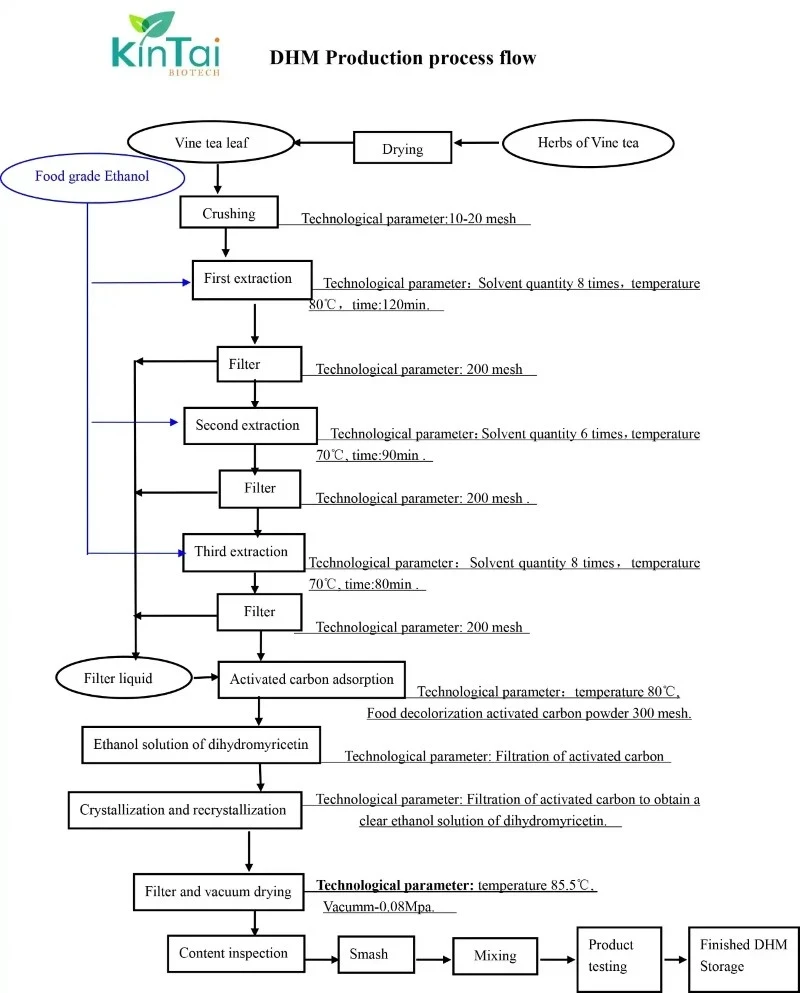
Raw Material Selection and Pretreatment
We use young Ampelopsis grossedentata leaves harvested around Qingming, which contain 20–30% more best dihydromyricetin than mature leaves. Pretreatment includes rapid drying at 60°C to below 8% moisture, followed by grinding and 40-mesh sieving to increase surface area for better extraction.
Microwave‑Ethanol Synergistic Extraction
Our patented process uses 60% food‑grade ethanol at a 1:15 solid‑liquid ratio, with 500W microwave irradiation at 60°C for 50 minutes, achieving over 90% extraction yield, while a closed‑loop system recycles ethanol to keep losses under 5%.
Optimized Water Extraction
As a low‑cost alternative, pure water extraction at a 1:20 ratio and 80°C for 2 hours gives 85% yield, and three‑stage dynamic countercurrent extraction reduces solvent usage by 30%.
Primary Purification
The extract is vacuum‑concentrated at 40°C (wastewater BOD<100), then adjusted to pH 6 to precipitate impurities, followed by activated carbon decolorization.
Advanced Purification
AB‑8 macroporous resin chromatography with ethanol gradient elution raises purity to 95%, and two low‑temperature recrystallization cycles in a 4:1 ethanol‑water system yield ≥98% purity with 75% recovery.
What is dihydromyricetin mechanism of action?
Dihydromyricetin (DHM) exhibits a multi-target, multi-pathway mechanism of action, primarily by directly binding to and inhibiting the activity of key signaling proteins to regulate various cellular physiological processes. In terms of anti-inflammatory and anti-fibrotic effects, DHM can directly and stably bind to the active pocket of sphingosine kinase 1 (SphK1), thereby inhibiting its enzymatic activity, reducing activation of the downstream NF-κB pathway, and consequently decreasing the expression of inflammatory adhesion factors such as ICAM-1 and VCAM-1, thus exerting a nephroprotective effect.

Regarding anti-oxidative stress, dihydromyricetin bulk can activate the miR-34a-mediated Notch1 pathway or inhibit the miR-217/MAPK pathway, thereby reducing cardiomyocyte apoptosis and oxidative damage. Furthermore, wholesale dihydromyricetin powder can reduce neuronal apoptosis and Tau protein phosphorylation by inhibiting the JNK signaling pathway and endoplasmic reticulum stress (ERS), improving cognitive dysfunction, and exerting anti-tumor activity through inducing cell cycle arrest and apoptosis.
dihydromyricetin vs myricetin
Dihydromyricetin and myricetin have extremely similar structures, the only difference being that dihydromyricetin has a single bond at the 2,3 positions of its C ring, while myricetin has a double bond. This subtle difference leads to significantly different properties: myricetin, due to its larger conjugated system, performs better in certain electron transfer-dependent antioxidant reactions; however, dihydromyricetin, due to its more flexible molecule, is more active in scavenging superoxide anions and chelating metal ions.

More importantly, their performance in vivo differs greatly-under the same conditions, the blood concentration of dihydromyricetin DMY is much higher than that of myricetin, meaning that it is absorbed and utilized by the body much more efficiently, while myricetin is relatively difficult to be fully absorbed into the bloodstream.
What are dihydromyricetin benefits?
dihydromyricetin for hangover
Dihydromyricetin's hangover-relieving effects are mainly manifested in two aspects: Firstly, it acts on the central nervous system, blocking the enhancing effect of alcohol on GABA(A) receptors in the brain, thereby reducing symptoms such as drowsiness and ataxia caused by drunkenness, and alleviating alcohol withdrawal symptoms; secondly, it protects the liver, reducing alcohol-induced oxidative damage to liver cells by lowering reactive oxygen species (ROS) levels, while also improving alcohol-induced liver fat accumulation and inflammatory responses, thus reducing alcohol-induced liver damage.

dihydromyricetin for anxiety
Dihydromyricetin bulk powder has demonstrated clear anti-anxiety effects in animal studies, with its mechanism of action involving multiple levels. It can restore ATP levels in the brains of anxious animals, thereby stabilizing gephyrin protein expression and enhancing inhibitory neural signals in the brain. Furthermore, it can alleviate oxidative stress by improving mitochondrial function and increasing the activity of antioxidant enzymes, and regulate the BDNF signaling pathway to promote neural plasticity, while simultaneously inhibiting stress-induced neuroinflammation.

dihydromyricetin for blood pressure
Regarding the effects of dihydromyricetin on blood pressure, in a salt-sensitive hypertensive mouse model, vine tea extract rich in dihydromyricetin effectively reduced systolic blood pressure. The mechanism is believed to be through regulation of the gut microbiota-metabolite axis. The antihypertensive effect of dihydromyricetin may depend on the specific causes of hypertension, and its cardiovascular protective effects may stem more from its antioxidant, anti-inflammatory, and cardiac remodeling-improving properties than from direct blood pressure regulation.

dihydromyricetin for weight loss
The core efficacy of dihydromyricetin in weight loss lies in promoting the "brownification" of white adipose tissue, thereby increasing energy expenditure. Its mechanism primarily involves upregulating the expression of brown adipose tissue markers such as UCP-1 and PGC-1α, and enhancing mitochondrial division, converting energy-storing white adipose tissue into heat-generating "beige" adipose tissue. Furthermore, it can correct lipid metabolism disorders in adipose tissue and inhibit triglyceride synthesis.

dihydromyricetin for sleep
Dihydromyricetin has a clear effect on promoting sleep and improving sleep quality. Animal experiments have shown that dihydromyricetin can significantly prolong sleep time and shorten sleep latency. Its mechanism of action involves multiple aspects: it can exert a sedative-hypnotic effect by enhancing the inhibitory function of the GABA ergic nervous system, and it can also promote the secretion of melatonin by the pineal gland to regulate sleep rhythm. In addition, dihydromyricetin can also reduce the damage of sleep deprivation to the body by anti-oxidative stress, and significantly reduce nocturnal activity and restore key physiological indicators in a sleep-deprived fruit fly model.

What are Dihydromyricetin Uses?
dihydromyricetin supplement
Dihydromyricetin (DHM) has diverse applications in the health supplement industry, forming a product matrix dominated by oral supplements. The most common dosage forms are dihydromyricetin pills and dihydromyricetin capsules, typically using vine tea extract as a raw material. Targeting the core needs of relieving hangovers and protecting the liver, there are specialized hangover recovery formulas on the market, some of which are also combined with electrolytes to aid recovery. In addition, corresponding functional health products have been developed to address metabolic health needs such as improving obesity and regulating blood lipids.

Dihydromyricetin functional food and beverage
In the functional food and beverage sector, DHM applications primarily focus on two main areas: hangover relief and liver protection, and metabolic health. The most representative example is ready-to-drink hangover functional beverages, typically centered around DHM-containing vine tea extract, combined with electrolytes, B vitamins, and antioxidants, aiming to accelerate alcohol metabolism and alleviate hangover symptoms during or after drinking. Solid beverage powders are another common form, combining customized dihydromyricetin powder with kudzu extract, citric acid, and other ingredients into convenient small packages that are dissolved in warm water, suitable for use in social drinking situations.
What are Dihydromyricetin Side Effects?
Toxicological Considerations
KINTAI's Dihydromyricetin Powder demonstrates low acute toxicity. Animal studies have revealed that the oral LD₅₀ value exceeds 2000 mg/kg, suggesting a negligible risk of severe acute harm at normal usage levels. No significant adverse effects have been reported in human applications within the recommended dosage range. Although chronic exposure is considered generally safe, consuming extremely high concentrations might lead to mild symptoms such as digestive discomfort or nausea in some sensitive individuals. To safeguard consumer well - being, KINTAI regularly conducts comprehensive toxicity tests, ensuring strict adherence to safety regulations.
Quality Control & Safety Certifications
Manufactured in facilities that fully comply with Good Manufacturing Practice (GMP) standards, KINTAI's 98 dihydromyricetin vine tea extract for business consistently maintains a purity level of ≥98%, as accurately verified by High - Performance Liquid Chromatography (HPLC). Every batch undergoes meticulous testing for heavy metals, with limits set at Pb ≤2ppm and As ≤1ppm. Additionally, residual solvents and microbial safety are rigorously examined. A detailed Certificate of Analysis (COA) and Material Safety Data Sheet (MSDS) are provided for each batch, confirming compliance with international safety benchmarks established by the FDA, EFSA, and WHO.
Why Choose Dihydromyricetin Powder by KINTAI?
We pride ourselves on the integrity and purity of our dihydromyricetin (DHM) raw materials, and we firmly promise that all our source plants are naturally grown under strict agricultural standards, free from any artificial additives, pesticides, or chemical contaminants. Beyond offering high-quality standardized extracts, we provide fully customized DHM extraction solutions tailored to meet your specific product requirements. Our manufacturing facilities operate under rigorous quality management systems and have successfully passed multiple internationally recognized certification, ensuring that every batch meets the highest standards of safety, consistency, and traceability. Wholesale dihydromyricetin powder, please do not hesitate to contact us at info@kintaibio.com.

FAQ
Q: What is another name for dihydromyricetin?
A: Ampelopsin, also known as dihydromyricetin and DHM, when used as an herbal medicine, is a flavanonol, a type of flavonoid.
Q: Does DMY help with hangover?
A: It is known for centuries in traditional Chinese medicine as a cure for alcohol poisoning and hangover.
Hot Tags: dihydromyricetin powder, China dihydromyricetin powder manufacturers, suppliers, factory, turmeric powder with black pepper, Artichoke Extract Powder, Ampelopsis Grossedentata Extract, white mulberry leaf extract powder, melatonin in powder form, Wheat Germ Extract Powder


